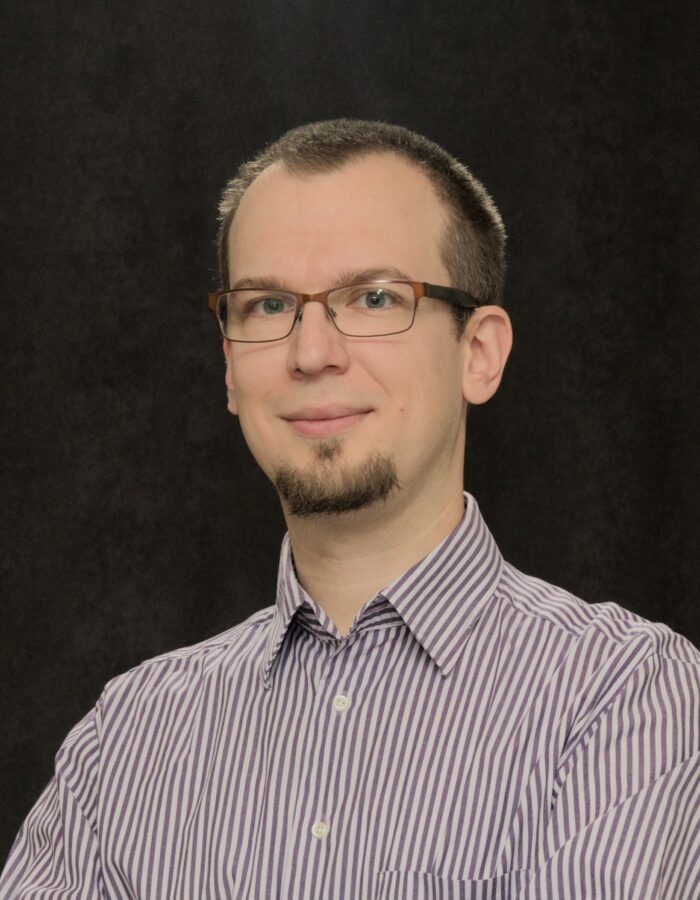
Marcell Stippinger studies the interactions between subsystems of complex networks using causal analysis methods. A central question driving his work is whether the relationships between dynamic systems can be inferred from observations alone and whether the underlying network of interactions can be reconstructed without resorting to interventional experiments. He completed his studies through the TIME double-degree program, graduating in physics from BME (Budapest University of Technology and Economics) and in engineering from École Centrale de Lille. His master’s thesis addressed the efficient pricing of credit derivatives. His doctoral dissertation extended this interest in the risk due to network interdependence: he used computational physics to investigate breakdown phenomena that arise during crises. Through simulations, he demonstrated how cascading failures propagate in mutually interdependent networks and explored potential recovery mechanisms.
Marcell joined the Wigner Research Centre for Physics in 2016. While getting acquainted with theoretical neuroscience, he applied machine learning techniques to quantify how neural representations shift during adaptation. His current work examines brain information processing through a network perspective, with a focus on the interaction dynamics between different brain regions. He is developing causal analysis tools that can identify source and target areas and detect hidden drivers of neural activity. One promising application of this work is pinpointing the onset zones of epileptic seizures. At BME’s Faculty of Natural Sciences, he teaches a course on causal analysis of time-series, and he regularly mentors secondary school students at the Wigner Research Student Camp.
Through the HUNRENTECH grant, he is putting his engineering and neuroscientific expertise to work on a closed-loop focused ultrasound stimulation system designed for use in rodent studies.
Since 2024, he has been serving as one of the artificial intelligence ambassadors at HUN-REN Wigner RCP, supporting colleagues in harnessing AI effectively for physics research and helping them navigate the coming changes, the expected AI-driven transformation and acceleration of science. He has also collaborated with researchers at Morgan Stanley and Cursor Insight on simulation and machine learning projects.
He is married with four children. In addition to his work, he enjoys photography and tinkering with microelectronics projects.