
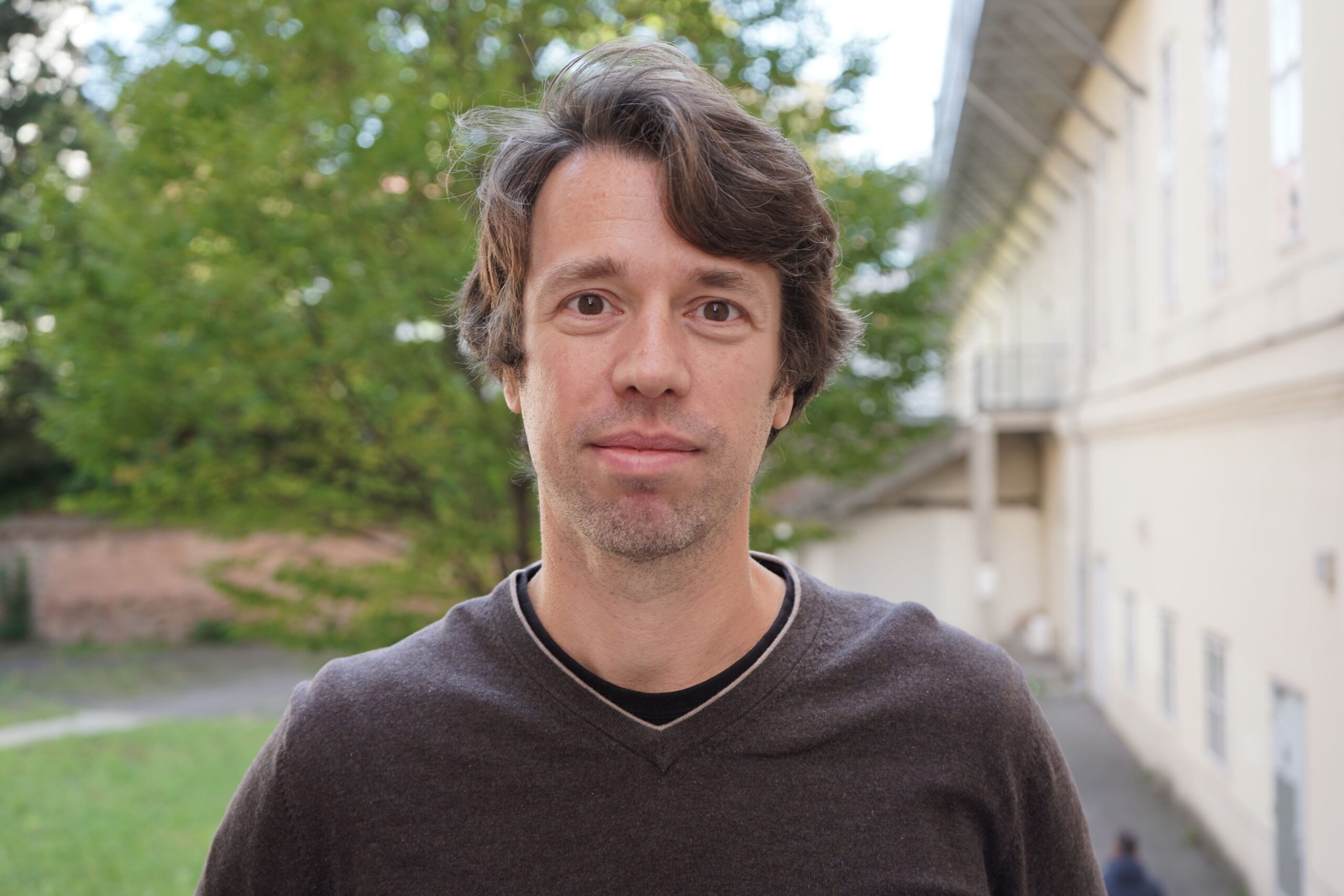
Balázs Hangya, neuroscientist, doctor and mathematician, has been a Professor and Head of Department at the Medical University of Vienna from October 2025. From 2015 to 2025, he worked as a research group leader at the Institute of Experimental Medicine in Budapest. Previously, he was a postdoctoral researcher at Cold Spring Harbor Laboratory. He obtained his medical degree and PhD from Semmelweis University, and his degree in Mathematics from ELTE. His work has been recognised with several prestigious grants and awards, including the ERC Starting Grant, the ERC Proof of Concept Grant, the Hungarian Academy of Sciences (MTA) Momentum Programme start-up grant, the Junior Prima Award and the Semmelweis University PhD Mentoring Award.
In the next part of our interview series, we spoke to neuroscientist Balázs Hangya, who primarily investigates the neural mechanisms underlying cognitive behaviours. His research focuses on examining the neural basis of learning, decision-making, attention and memory; his scientific interests range from uncovering fundamental mechanisms, through animal models of disease, to human research. His career is particularly characterised by the convergence of his medical and mathematical training, his quantitative approach, and his commitment to supporting young researchers.
Could you begin by briefly summarising your current research topic for us?
We are primarily interested in the brain mechanisms underlying behaviours related to thinking – in other words, cognitive behaviours. For example: how does the brain learn? How does our brain determine how much information is sufficient for us to make decisions? How do different stimuli and thoughts compete for our attention?
What is your strongest professional driver?
Initially, I was motivated by a desire to understand how the brain works and the challenges associated with this. However, as a doctor, my main motivation for many years now has been to ensure that this knowledge benefits humanity as much as possible. We mostly investigate fundamental mechanisms, but always with a view to how this can contribute to a better understanding and treatment of disorders of cognition, learning and memory. In line with this, both animal models of disease and human research are gaining an increasing importance in our work.
Could you tell us about any formative experiences or people who led you towards a career in science?
A particularly influential teacher for me was Dr Erzsébet Müllner, my biology teacher at the Mihály Fazekas Secondary School, who prepared me for the National Secondary School Academic Competition ("OKTV") in Biology with remarkable efficiency. It was clear that my successes were not down to my "innate genius", but to her efforts to equip me for the competition. Everything begins with laying the foundations in basic education, so we have a million reasons to hold the teaching profession in high regard.
Tell us about the challenges you faced during your university years and the early stages of your career.
As well as medicine, I also completed a degree in Mathematics (back when it was a five-year integrated programme). This was not only a formative experience, but also had a decisive influence on my career: my work in brain research is characterised by a quantitative approach and the diverse application of mathematics. I even have a purely theoretical paper consisting entirely of theorems and proofs, with plenty of integration.
To mention another kind of challenge: I felt very uncertain during my PhD studies. Before my first paper, I wasn't sure whether I would be capable of producing and publishing a single piece of genuine scientific work. At that time, analytical work was not highly regarded in the "Hungarian school"; I was "just a programmer" and I was told that "this isn’t scientific work". Later on, in the U.S., I was surprised to see that the analyst was often the first author, and that mathematical knowledge was highly appreciated – this was very liberating. As far as I can see, fortunately, there is now much greater respect for analytical and modelling work in Hungary as well.
What kinds of managerial attitudes have you encountered during your career? Feel free to share both positive and negative experiences.
I was a rather "autonomous" PhD student – or, to put it another way, one left to his own devices – and I was also a postdoc under closer supervision, i.e. one who benefited from "regular supervision": both approaches had their ups and downs. I believe that being encouraged to work independently is an essential step in "growing up" as a researcher, and the sooner this attitude is acquired the better – certainly better than learning it later the hard way from your first independent grant application. It is important to bear in mind that the supervisor–supervisee relationship always involves the personalities and attitudes of both parties: it is worth consciously viewing this as a feature rather than a bug. I owe a great deal to my PhD supervisor, Viktor Varga, and my postdoc supervisor, Adam Kepecs, not in spite of their differing approaches, but rather because of them. In my view, leadership attitudes and communication culture have, unfortunately, hit rock bottom in Hungary; the poor examples set by the country’s leaders have trickled down to every level. Every leader should feel the responsibility that comes with their position and be aware of what is and is not permissible when in a position of authority. I deliberately said "rock bottom", which also implies I am optimistic that we will now start moving upwards from here.
Have you ever experienced failure from a professional point of view, and what helped you get over it?
In this profession, you will encounter far more failures than successes. The success rate for grant applications usually ranges between 3 and 15 per cent, with 10 per cent considered average. If I win one out of every ten grant applications I submit, I am already satisfied. Due to the extremely fierce competition, we have to publish in the very best journals just to stay afloat. Who remembers the swimmer who finishes eighth in the Olympic final? Yet he or she must be a fantastic swimmer who has put in a huge amount of hard work. Our situation as researchers is pretty similar: it is often something of a miracle if a journal even considers your manuscript at all. What is more, in this situation, unfortunately, non-academic factors also start to come into play (such as how prestigious the university is from which you are submitting the article), factors over which you have very little control.
That is why academic work is basically a constant series of setbacks, occasionally punctuated by the odd success. There are certainly individual differences here – even after some twenty-odd years, I still find it difficult to cope with who knows how many rejections and carry on working the next day with undiminished motivation. Maintaining a balance between work and private life certainly helps; for me, for example, active leisure, travel, nature, sport, music and the theatre do me a world of good. Everyone needs to look after their mental health, because it’s hard to recover from burnout.
In your opinion, how could the Hungarian Young Academy or the younger generation of researchers most effectively advocate for early-career researchers?
First of all, HYA must become a visible, tangible force. From the outside, it seems to me – perhaps I am mistaken, but perception itself is important – that HYA exists alongside the Hungarian Academy of Sciences (MTA) rather than being an organic part of it. HYA has no vote in the MTA Presidium, nor does it effectively appear as an integrated entity at the General Assembly. The press is not making much noise about HYA, either, even though the independent press has recently been full of reports about attacks on science. Young people need their interests to be represented and upheld, and the Hungarian Young Academy could help the most by ensuring that young people see the weight HYA carries. If the Hungarian Academy of Sciences regains control of the research institutes (which I hope it will), that will also entail responsibility. Their story cannot simply be picked up where it was left off seven years ago, because seven years have passed in the meantime, and the structure – one might say – was not exactly modern even back then. At present, there seems to be a moment of grace for this, and presumably, all the stakeholders and decision-makers are also in for it, but like in any organisation, there will be many who will lose out from the reforms. HYA must be on its guard to ensure that it represents the interests of young researchers actively, credibly and very visibly throughout this process.
What do you think of Hungarian researchers’ prospects in international competition?
The prospects of Hungarian researchers in the competition for international research funding and prestigious international positions are, at best, only moderately good today, and tend to deteriorate as their careers progress. After secondary school, Hungarian students are capable of getting admitted to prestigious Western European universities, but the more time someone spends within the Hungarian system, the further behind they fall. Whilst we have been preoccupied with our internal struggles over the past decade(s), the Western world has swept past us. Competition is growing in well-functioning and attractive institutions because everyone is applying there, whereas it is declining in less attractive ones. This is why extremely fierce competition has developed in Western Europe and the US, with hundreds, sometimes thousands, applying for a single good position, while in Hungary even the largest universities are not always able to fill their doctoral programmes – which are often minuscule by international standards. Another issue is that, in my view, this level of competition is not necessarily beneficial to either science or those working in the field – yet this is a social process over which we have no direct influence. Hungary must open up now, integrate and catch up with the rest of the Western world.
This interview is part of an interview series by the Hungarian Young Academy, titled "Success stories of early-career researchers – Life paths and achievements", in which we present the professional and personal journeys, successes, sources of inspiration and challenges of young Hungarian researchers. Click here to read more interviews in the series: https://fka.mta.hu/en/interviews/.