
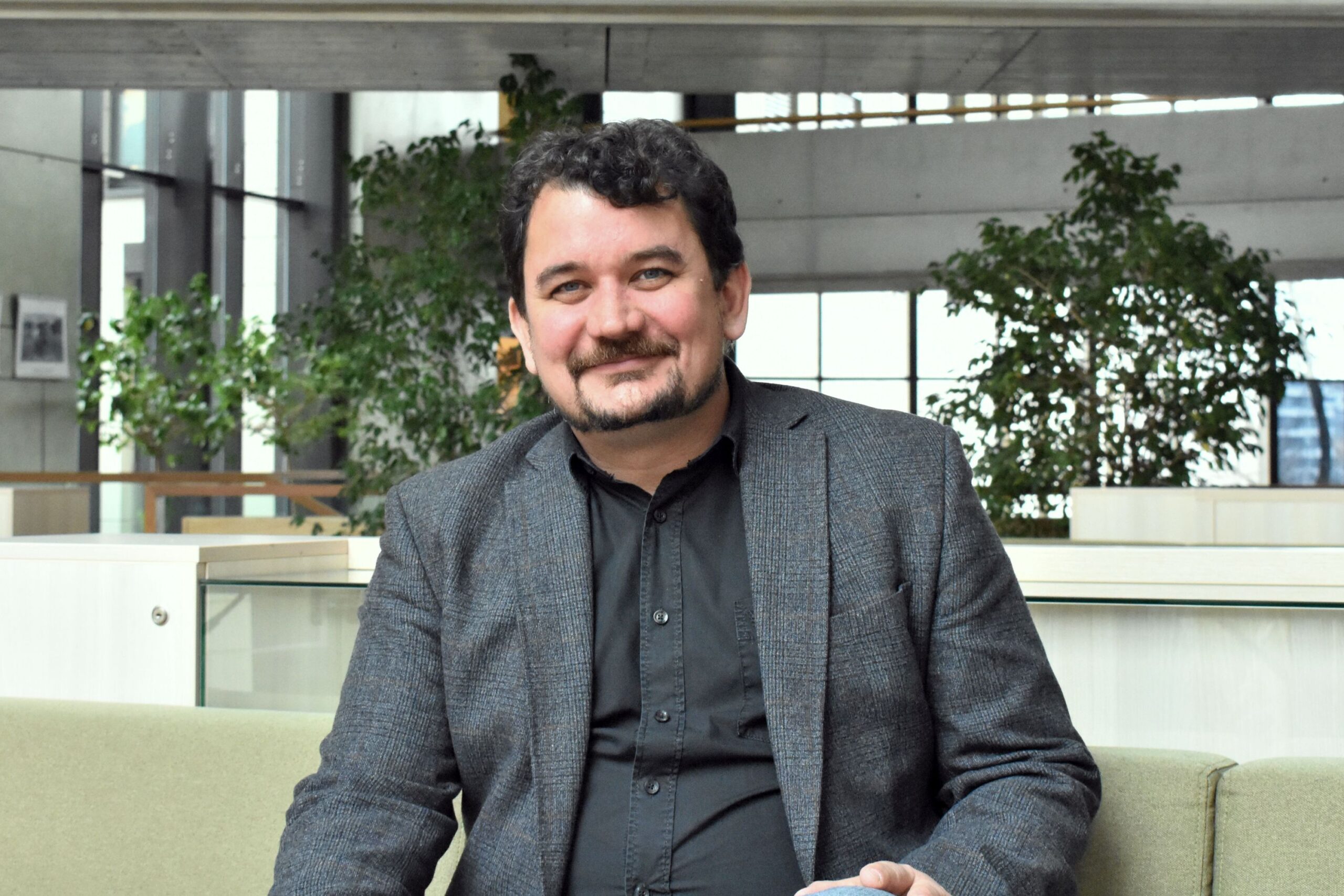
Gábor Kármán defended his doctoral thesis on early modern Hungarian history at Eötvös Loránd University in 2009, and the following year he also obtained a doctorate in the comparative history of Central, South-Eastern and Eastern Europe from the Central European University. Between 2008 and 2013, he was a research fellow at the Geisteswissenschaftliches Zentrum Geschichte und Kultur Ostmitteleuropas (GWZO) in Leipzig; since then, he has worked at the Institute of History within the Hungarian Academy of Sciences’ Research Centre for the Humanities (and its various successors under different names). In 2022, he was awarded a European Research Council Consolidator Grant, under which he and his team are investigating the diplomacy of small states between the Ottoman Empire and Christian Europe in the 16th and 17th centuries.
In the next part of our interview series, we spoke to historian Gábor Kármán, who believes that embarking on a research career involves numerous difficulties, and this is particularly true for early-career historians. Although talent and diligence alone are not entirely sufficient to build a successful career, they are certainly among the most important pillars. As with everything in life, a bit of luck is sometimes needed, but luck usually comes knocking at a researcher’s door when they carry out their work with enthusiasm and sufficient determination.
What do you think were the key milestones on the path to a successful ERC application?
My application goes back quite a long way. In 2009, together with a Croatian friend of mine – who specialises in the history of Raguza (now Dubrovnik, Croatia) and was a fellow student of mine at CEU – we organised a conference on the comparison of Ottoman vassal states. This was made possible by our research project at the GWZO, and it was also thanks to my time in Germany that I got to know the colleagues who are now key figures in the ERC group. The task we have undertaken is to write a joint monograph, which is based on preliminary studies written according to a unified set of criteria, and whose chapters are designed to present relevant thematic areas rather than individual regions. This requires very close cooperation and a relationship based on trust – I would not have dared to take on such a project, had I not known the potential participants for a long time and had we not worked together on bringing various collections of studies to fruition. After I returned home, another conference organised in 2015 (again with German funding, although this time I had applied for the grant myself) strengthened these academic ties and paved the way for me to work on the grant application together with the team members in 2021.
What is the role of mentors in building a successful academic career in your opinion?
I consider myself fortunate to have met numerous people during my university years from whom I learnt a great deal about how to investigate my specific topic in such a way that I could simultaneously highlight important, new and previously unexplored phenomena in the history of 17th-century Transylvania, whilst also interpreting it within a broader context. I would refrain from listing names not only because that would require considerably more space, but also because I do not think I could single out which of them played a decisive role in making this interview with me possible. I have never had a single mentor – fortunately, history writing is a profession in which most people do not expect this kind of very strong personal bond, and I am convinced that this would not be right anyway, since a valid interpretation of the past can only be formed through the juxtaposition of numerous differing interpretations.
In your view, what pitfalls might there be in an academic career, and what difficulties must a young researcher preparing for an international grant face in Hungary today?
It is incredibly difficult to be a historian just starting out on your career. It was already like that during my PhD years, and the situation – as far as I can tell – has deteriorated considerably since then. I ended up in Leipzig after being awarded a visiting researcher’s scholarship for two and a half months, which came at the very best possible time, because my PhD scholarship had run out and odd jobs wouldn’t have lasted very long – and if I had had to take a regular, eight-hour-a-day job, I wouldn’t have had the chance to complete not just one, but two dissertations. When the possibility arose that I might be able to stay on in Germany in a permanent post after my visiting research fellowship, I rang my head of department at ELTE and asked him whether I was right in thinking that I had no chance of staying on in the department (despite the fact that by then I had already become involved in the work there in many different ways). He confirmed that it would be irresponsible of him to promise me anything. So I was incredibly lucky with Leipzig, just as I was when, upon the expiry of my two three-year project posts there, there were people at the Institute of Historical Studies who saw potential in me. Of course, it is also true that I did everything in my power to make it happen. I think It would have never worked out if not for the fortunate combination of these two factors.
Apart from the difficulties, can you list any motivating factors that might be helpful for the younger generation?
Unfortunately, I can’t answer that question, because once again I am just lucky. This time, it is because I am naturally wired in such a way that I have never had to struggle with burnout. My close friends and colleagues sometimes remark in disbelief that I am able, year after year, to speak with unflagging enthusiasm about the historical issues that are currently captivating me, be they broader structural questions or the previously unrecognised yet significant – or at least characteristic – details of individual episodes that transcend their own scope. Of course, it helps a great deal that those around me generally share that same spark, which allows me to see, through their reaction, that what I am doing does indeed make sense.
To what extent does the current Hungarian research ecosystem support – or, indeed, hinder – researchers who are just beginning to make their mark on the international stage?
My impression is that, alongside the disgracefully low PhD stipends and the glaring lack of a clear career path for researchers, (in other words, it is by no means certain that talent and hard work alone are sufficient to launch a successful career), stepping onto the international stage has actually become somewhat easier compared to the situation fifteen to twenty years ago – at least for those who actually aspire to do so. Many institutions are able to provide some level of support for conference travel, and from time to time international grants can also be obtained to fund such trips. If someone is open to this and feels the need to share their findings with a community whose members often lack not only basic knowledge of the region but also ask questions in a different way (from which you can learn a great deal), they will find a way to fund it.
Do you think there is such a thing as a "typical" research career path that can lead to a successful ERC grant application?
Unlike in the natural sciences, where the main difference between a national grant scheme and an ERC grant lies in the amount of funding available, in the humanities the logic behind major European grant schemes differs from that of Hungarian ones. The ERC operates on the premise that the role of Member States’ own grant schemes is to fund a more in-depth understanding of the history of the field in question (which is precisely why the reorganisation of NRDIO calls two years ago seemed disastrous for humanities scholars, as the designers of the new system prioritised the ERC model and internationalisation). Calls funded at European level virtually always promise comparative research, or at the very least research that transcends national borders. Thus, the decisive factors for securing a successful ERC grant in the humanities are an openness to this approach, a willingness to examine the past and its legacy within a context broader than the national one, and the aforementioned ability to make our findings understandable and interesting to people from different backgrounds. In my view, there are many different career paths that can take you to an ERC.
Is there a Hungarian, or perhaps a Central European, grant scheme that helped you to successfully secure the grant?
It did not yet exist when I was preparing my ERC application, but following the award of the first two grants at the Institute of Historical Studies, a workshop programme was launched to guide talented young researchers working at the research centre – and those with an interest in the subject – towards submitting a successful application. Béla Vilmos Mihalik, who took part in this programme himself, could report on this in more detail. No targeted grant scheme helped me, nor am I aware of any similar schemes in the region.
This interview is part of an interview series by the Hungarian Young Academy, titled "Success stories of early-career researchers – Life paths and achievements", in which we present the professional and personal journeys, successes, sources of inspiration and challenges of young Hungarian researchers. Click here to read more interviews in the series: https://fka.mta.hu/en/interviews/.