
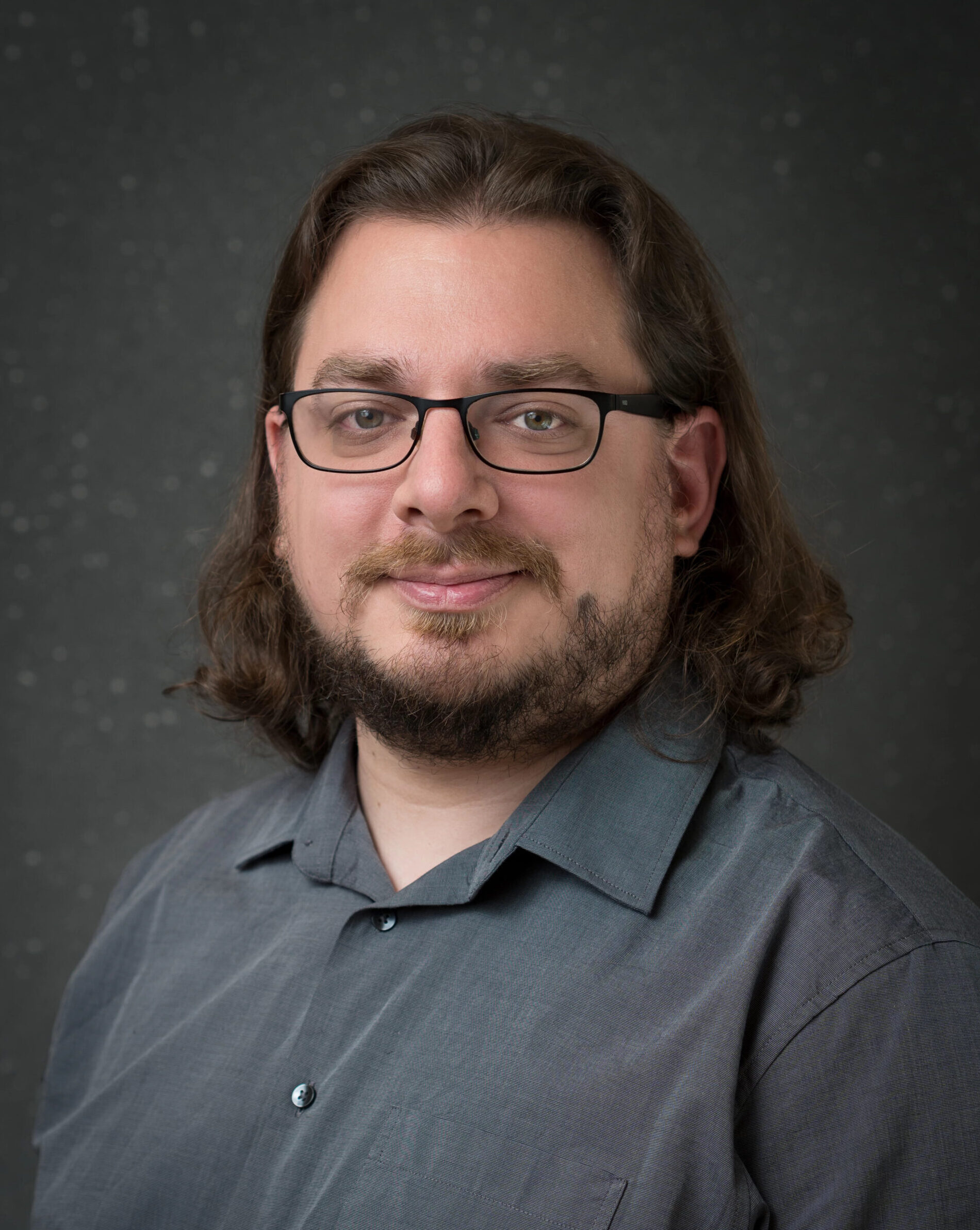
László Molnár, astronomer and senior research fellow at HUN-REN Research Centre for Astronomy and Earth Sciences, has been working at the institute since 2008. During his career, he has been awarded the Junior Prima Award, the Bolyai János Research Scholarship and several independent postdoctoral grants. He currently heads the Stellar Seismology Laboratories research group, funded by the NRDIO Research Excellence Programme’s "Forefront" grant, and is also one of the coordinators of the Konkoly Student Programme at the Konkoly Observatory.
In the third episode of our interview series, you can read about László Molnár, an astronomer and senior research fellow at HUN-REN Research Centre for Astronomy and Earth Sciences (CSFK), whose work focuses primarily on the life cycles of stars and the study of their physical properties. In 2021, he was awarded a five-year "Forefront" grant under the NRDIO Research Excellence Programme, which enabled him to establish an independent research group called the Stellar Seismology Laboratories. The members of the group are investigating several exciting areas: stellar populations, variations in stellar brightness and the information that can be derived from their physical parameters, as well as stellar evolution and the modelling of stellar pulsations.
How would you sum up your current area of research briefly and clearly for the general public?
My main area of research is stellar physics: the study of the lives and physical properties of stars through the observation of their variations in brightness and the modelling of the oscillations occurring within them – this branch of science is known as asteroseismology, in parallel with terrestrial seismology. At present, I am most interested in red giant stars – which represent the future of our Sun – and supergiant stars, such as Betelgeuse and Antares, which are much larger and will eventually explode as supernovae.
What are your strongest professional motivations?
One of them is the joy of discovery: poring over the data until we stumble upon something new, perhaps something never seen before. The other is mentoring, something I have felt an ever-stronger urge to do over the years: I regard it as a professional challenge to introduce new generations to a researcher's career pathway and to help them with their first, often uncertain steps.
Do you prefer working on your own, or are you a team player?
I definitely prefer working as part of a team. One of my most exciting experiences so far was when, at the invitation of a colleague, the three of us got together at the Flatiron Institute in New York and, in the space of a week, wrote an entire academic paper on a topic we had been mulling over for some time, which subsequently received significant international attention. But we have also been running a small series of workshops with colleagues here at home on topics related to the solar system for quite some time now, which has also yielded numerous exciting results.
What sort of leadership attitudes have you encountered during your career?
Various kinds of attitudes. There were some negative experiences, where the leader had a hard time accepting when I expressed an opinion that contradicted theirs, but fortunately that was more the exception than the rule. I have always had a good relationship with most of my superiors I have worked with so far, including the current management at CSFK. For me, it is important that a leader does not confuse hierarchy with dominance, but treats their subordinates as partners. Amongst the qualities I would highlight, I would also emphasise that a manager shouldn’t just give feedback when there’s a problem, but should also recognise when work is progressing well; and that, as leaders, they should be reliable – meaning that, as a subordinate, I can count on them. I try to put this into practice myself in my leadership role.
Is there a person or a mentee whom you have had a chance to support during their professional career? What are your experiences in this respect?
Definitely. What is more, I mentor numerous young researchers not only as a principal investigator, but also as one of the leaders of the Konkoly Institute's university student programme. Although we are not an educational institution, as the largest centre for astronomy in Hungary, we place significant emphasis on nurturing talent. Although this sometimes means a lot of work on top of my research, I find it extremely rewarding.
I have worked with postdoctoral researchers from abroad who had to tackle the challenges of establishing themselves professionally while also adapting to a new language and a new social environment. I also particularly enjoy helping students emerging from the student Olympiad movement to launch their careers. I would not be able to list everyone, but if I had to say one name, let me just mention Csilla Kalup, who has already achieved significant professional success as a PhD student and with whom I have been working for more than seven years, now also as co-coordinators of the student programme.
Have you ever had to face a professional failure, and if yes, what helped you to get over it?
Yes, of course. One of the key insights I pass on to my mentees is that research work is quite different from their university education. Unlike a failed exam, setbacks – whether it is a research idea that doesn't pan out or a rejected grant application – are a natural part of this profession. For me, perhaps the most defining experience of failure was my ERC Starting Grant application, which ultimately fell just below the funding threshold in the second round of evaluation – that was certainly harder to come to terms with. At the same time, however, this paved the way for my NRDIO "Forefront" grant application, which enabled me to start my own research group. What helped me get over the experience was realising that I needed to learn to assess what factors I could influence in such a situation, and which ones were beyond my control. I can write a stronger grant application, but I cannot influence the decision of an evaluation panel in any other way. The outcome depends on them too, so it is not entirely up to me.
How were you able to align the chores related to having children and a family with your professional career? What advice would you give to young researchers in that respect?
Since my wife is also a researcher, we actually have to balance two careers with having children. Right from the start, we have tried to share the tasks fairly between us, so that all the responsibility would not fall on the shoulders of just one parent. My advice to young researchers is that they should expect a similar level of cooperation and effort from their partner, with whom they are starting a family and having children, so that their careers do not suffer more disruption than is necessary.
What would you recommend to young researchers who wish to follow in your footsteps?
Research is a profession that can be learnt: surely, it requires talent and effort, but it is not the exclusive territory of natural-born geniuses. My advice would be to have confidence in their own abilities, learn from those who have gone before them in their careers, not be afraid to ask questions, and work hard on their own development. This can be quite demanding, of course, so they also need to be careful not to let it wear them down mentally. You just need to stop from time to time and look back at what you have achieved so far, and what your goals were back when you were starting out. Identifying suitable mentors – even beyond your own supervisor or superior – can also be a huge help in making progress.
In your opinion, how could the Hungarian Young Academy or young researchers as a community take action the most effectively to advocate for researchers in the early stage of their career?
The young research community could double its strength through organisation and the power of community-building: we can clearly see the positive effects of this, for example, amongst the students and young researchers at the Institute of Astronomy. One of the key lessons from our student programme so far is that it is enormous relief for early-career researchers if they do not work in isolation, without any points of reference, but can instead observe and support each other’s development. The Hungarian Young Academy could also help by recommending such talent development programmes and models to other institutions and research centres.
In addition, I consider it very important to lobby for funding opportunities for young researchers, whether this involves existing funding schemes, such as the further fine-tuning of the EKÖP, or sorting out some of the "surprising" ideas and funding arrangements surrounding the recently devised multi-tiered doctoral programme, which would effectively reduce traditional doctoral training to sort of a hobby. I also consider it extremely important to advocate for the reinstatement of full, independent postdoctoral grants. Hungary has an abundance of talent: it is time to finally harness this through well-functioning systems.
This interview is part of an interview series by the Hungarian Young Academy, titled "Success stories of early-career researchers – Life paths and achievements", in which we present the professional and personal journeys, successes, sources of inspiration and challenges of young Hungarian researchers. Click here to read more interviews in the series: https://fka.mta.hu/en/interviews/.