
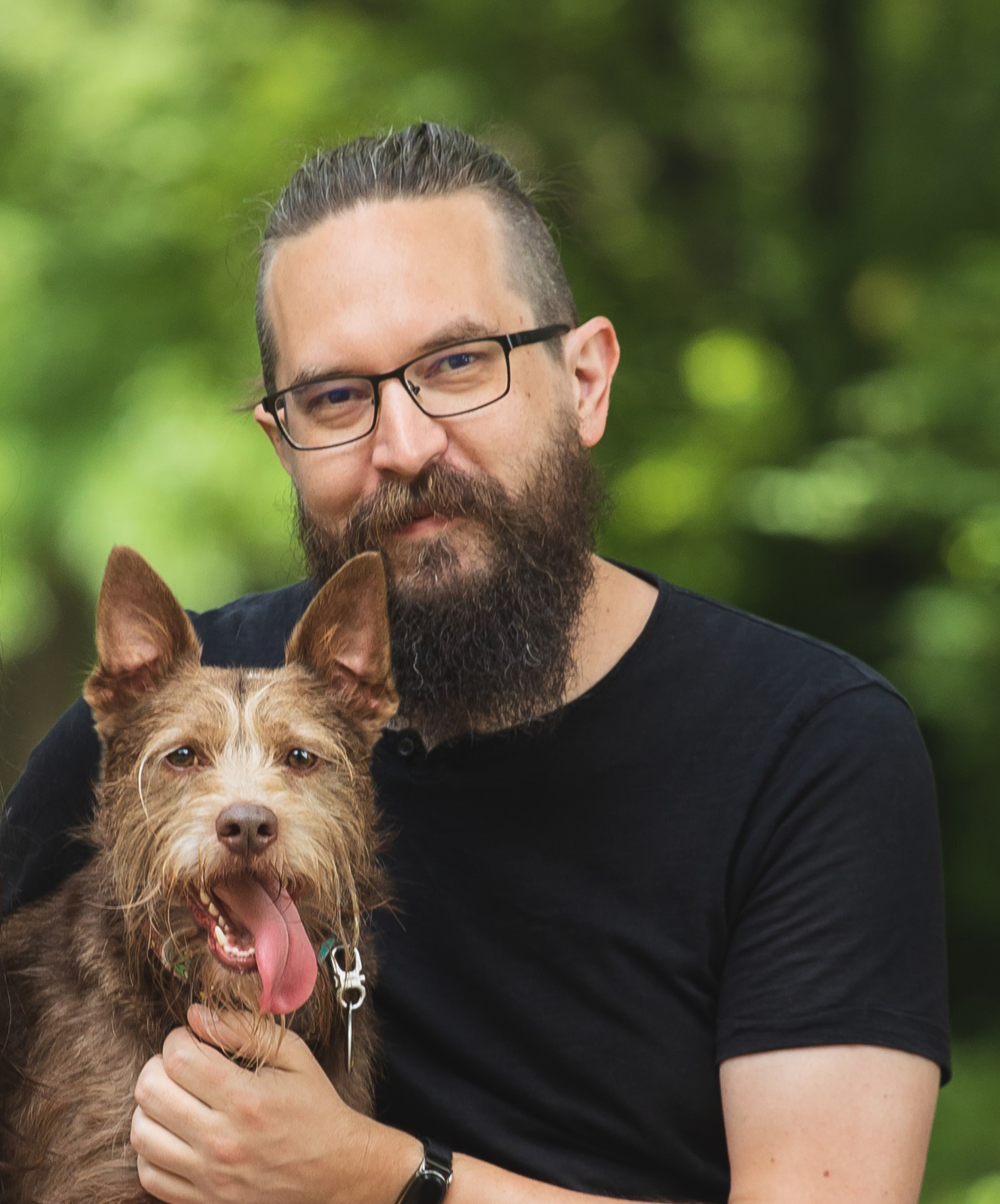
Tamás Faragó earned an MSc in biology in 2006 and a PhD in ethology from ELTE in 2012. His research interests have focused on bioacoustics; throughout his career, he has studied the communicative functions of canine vocalizations, as well as the acoustic expression of emotions and internal states, in both intraspecific and interspecific contexts. He worked as a visiting researcher at the Clever Dog Lab in Vienna and the Messerli Institute, and received a postdoctoral fellowship from the Stanton Foundation, support from the Premium Postdoctoral Programme of the Hungarian Academy of Sciences, as well as Bolyai and Bolyai+ UNKP fellowships. In 2024, he was awarded an ERC Consolidator Grant, under which he founded the BARKS Lab, where he is currently researching dogs’ auditory learning abilities.
In our first interview, you can read about Tamás Faragó, a biologist specializing in bioacoustics and a senior research fellow at the Department of Ethology at Eötvös Loránd University. Tamás researches dog behaviour and communication, and thanks to his successful ERC Consolidator* grant, he launched his research group, BARKS Lab, in 2024. The project received over 2.5 million euros in funding from the European Research Council (ERC). The BARKS Lab research group is investigating how dogs use their voices and what role learning plays in this. The research not only contributes to a better understanding of canine communication but also brings us closer to understanding the origins of human language, even looking back to the period before the emergence of words.
Tamás was happy to share insights into his research career not only in this interview but also with the audience at the Young Researchers’ Forum held on 6 May 2026, where he provided a glimpse into his career and experiences.
What are you currently working on as a researcher, and what makes your work unique on an international level?
My team and I are studying canine vocalizations and vocal learning abilities. We are primarily interested in how domestication and selective breeding for specific tasks and cooperation with humans have shaped these abilities. The evolution of human language—and specifically how we acquired our uniquely high level of vocal learning ability—has long fascinated researchers. The novelty of our research lies in the fact that, unlike the classical models used to date (e.g., primates, dolphins, seals, songbirds), we are studying dogs, as they underwent selection processes during domestication that resemble early human evolution in several respects, as well as the factors influencing the emergence of vocal learning.
What motivates you most in your research, and what do you consider the greatest professional achievement of your career so far?
Mostly curiosity. I love the detective work involved in research: the way we seek answers to emerging questions, design experiments, and watch patterns emerge from the data. The excitement of this is a major driving force for me, as is the opportunity to work with smart, talented people. I consider my greatest professional achievement to have won the ERC grant, and the fact that this gave me an opportunity to form my own research group.
Which of your personal qualities have contributed most to your success?
My perseverance: the fact that I didn’t give up on my research career despite constant negative feedback. In addition, perhaps my willingness to help stands out: when someone comes to me with a problem, I immediately switch into problem-solving mode, which fosters collaboration and strengthens both close-knit and broader teamwork. At the same time, this attitude can sometimes cause difficulties in terms of time management and allocating energy.
Based on this, I assume you generally prefer working in a team?
Definitely in a team. The research we conduct is interdisciplinary, so it wouldn’t be possible to carry it out individually. In addition, the support provided by my colleagues in the department is very important to me.
What made you embark on an academic career, and what early experiences or people were decisive in this decision?
Even as a small child, I had a keen interest in nature, especially animals. I loved watching what they did. I actually have a very early memory—perhaps from when I was 2 or 3 years old—of a line of red ants marching across a playground. On TV, one of Attenborough’s series (perhaps Living Planet) was a “must-watch”, even though the opening credits—with their strange music, volcanic eruptions, and a frog jumping in slow motion—really scared the heck out of me. I often asked to be read “stories” from the book Nature in Pictures, which featured brief descriptions of various species. I also devoured Attenborough’s books, Durrell’s The Amateur Naturalist, and the Wonders of Nature series was particularly influential for me. My parents did a great deal to ensure that I eventually became a researcher: they supported my interest, for example, by patiently waiting for me on the way to kindergarten while I admired the firebugs at the base of a tree in the spring.
What challenges did you face during your university years and at the start of your career, and how did they shape your path going forward?
When I started college in 2001, we were the first biology majors at ELTE to begin with a student body of over 100. We often heard from our lecturers that it was no longer possible to effectively teach a class of that size. We were also a pilot year in the sense that two-tiered labs were just being introduced at that time, and the entire curriculum was being reorganized; our work wasn’t made any easier by the fact that many of the new courses didn’t yet have fully developed requirements. As a result, the second year was a brutal workload: tons of practical classes, preparing for reports week after week, and the first two major exams at the end of the year. I really struggled. It didn’t help that I lived in a dorm and had to coexist with many students who lived and studied at completely different paces. The backlog that built up during that time followed me throughout my university years, and it took a lot of hard work for me to finally graduate on time, in five years.
What leadership models have you encountered in your career, and what sort of experiences have you gained from working with your student mentees?
I have encountered many different leadership styles, each with its own benefits and drawbacks. Some preferred to take a hands-off approach and gave me a great deal of freedom, which was less stressful but also carried the risk of procrastination. Others monitored my work more closely, which was more stressful but also compelled me to perform better. Fortunately, I never had a truly negative experience in any of these cases. I have worked with many students; there were some I was able to guide all the way from their BSc to their PhD. This is both a great responsibility and an extremely inspiring experience, involving continuous mutual learning and growth. Currently, my research group gives me the opportunity to work with many talented students, for which I feel truly fortunate.
Was there a professional setback or low point that made you seriously consider leaving the profession? What ultimately helped you keep going?
I have had plenty of setbacks, but that is just part of the job, so in the long run, you just have to brace yourself. I was rejected twice for a scholarship-funded doctoral programme, so I had to complete my PhD as a self-funded student while working part-time. Fortunately, after a while, Ádám Miklósi saw potential in me, took me under his wing, and covered the costs through grant funding. As a young postdoc, I initially managed to win grants, but this suddenly turned into a string of rejections. At that point, with almost every new rejection, the thought of leaving research crossed my mind—most strongly when I felt I was running out of options, while my CV wasn’t yet strong enough for major grants. Submitting the ERC application was practically my last chance to start my own research group. There was no prospect of a university position, so I had already prepared myself for the possibility of having to give up research. Beyond my own determination, what helped me get through this period was the opportunity to work on the major grants of Enikő Kubinyi and Attila Andics. During this time, I learned a great deal about how research groups operate, which I can still put to good use today. In the end, I got lucky.
How difficult is it to balance work and personal life in a research career, and what advice would you give to young researchers in that?
It's very difficult. The freedom of a research career—the lack of strict working hours—can easily backfire, leading to constant work. Deadlines don’t stop on weekends, nor do they stop during time off or vacations. I struggle with this too, especially because I tend to take on too much. For me, personal relationships are the most important: my wife, our dog, my family, and my friends. I wouldn’t give any of these up for the sake of professional success. At the same time, there were things I would give up, such as the chance to get rich quick—and sometimes even sleep. Every now and then I wonder what would have happened if I’d given myself an extra year at university; perhaps my path to a PhD would have been smoother, but in the end, everything led me to where I am now, so I don’t think it would have been worth changing anything. I’d give young researchers two pieces of advice. First, take care of yourselves: if you find yourselves hunched over your laptop even during your time off and not present with your loved ones, it’s worth taking a step back and rethinking your priorities. Second, don’t be afraid to ask for help—whether from those around you or from a professional. Burnout is no joke, and our profession is particularly at risk in this regard.
And one more word of wisdom for young researchers: perseverance matters a lot. It is often the last try—or the one after the very last—that will succeed.
To what extent do you think your own field of research is appreciated by society?
It’s a mixed picture. Many people recognize what we do and are proud of it, yet there is a vocal group that finds it hard to accept that exploratory basic research also has a place in science funding. From this perspective, dog behaviour research is a particularly unique field: many people have their own opinions about it, formed through personal experience, and these sometimes manifest in rather condescending remarks. We also often encounter people who smile at us at first, not taking our work seriously, saying that “all we do is pet dogs all day long.” Furthermore, although I am in a fortunate position thanks to my grant, I have experienced firsthand and can see just how low the financial recognition of research work is.
In your opinion, how could the situation of young researchers be more effectively supported at the institutional or community level, for example by the Hungarian Young Academy?
In my experience, researchers who have recently earned their doctorates currently have very few meaningful grant opportunities to launch independent careers. At best, they can find positions in existing research groups—if such opportunities happen to arise—or they go abroad. I believe it would be very important to advocate for the development of funding programmes specifically targeting young, promising researchers—similar to the former Premium Postdoc program or the NRDIO PD and FK grants**, but in a more carefully designed form. In addition, related mentoring programmes, grant-writing workshops, and skills-building training would also be crucial.
What is your take on the chances of Hungarian researchers in the international competition?
In terms of knowledge, ideas, and resourcefulness, I believe we are absolutely competitive; however, limited opportunities and financial constraints pose a serious disadvantage.
Despite all the hardships, would you recommend scientific careers to the next generation?
Absolutely because it is an awesome ride despite all the difficulties.
* A prestigious European research grant, awarded by the European Research Council (ERC)—the European Union’s organization for supporting basic research—granted solely on the basis of scientific excellence, through a rigorous international review process, to enable established researchers (7–12 years after earning their PhD) to realize their large-scale, innovative ideas with their own research teams.
** The Premium Postdoctoral Researcher Programme was announced by the Hungarian Academy of Sciences between 2016 and 2019. The call for applications was open to researchers under the age of 40 who had achieved independent scientific results of international significance and were capable of designing an independent research programme of outstanding quality.
The PD (postdoctoral) and FK (young researcher) calls for proposals announced by the NRDIO were Hungarian state research grants until 2023, which were announced by the National Research, Development and Innovation Office.
The PD grant helped young researchers who had recently earned their doctorates to launch independent research careers, while the FK grant was available to more experienced young researchers who were leading their own research topics or a small research group.
This interview is part of an interview series by the Hungarian Young Academy, titled "Success stories of early-career researchers – Life paths and achievements", in which we present the professional and personal journeys, successes, sources of inspiration and challenges of young Hungarian researchers. Click here to read more interviews in the series: https://fka.mta.hu/en/interviews/.