
News
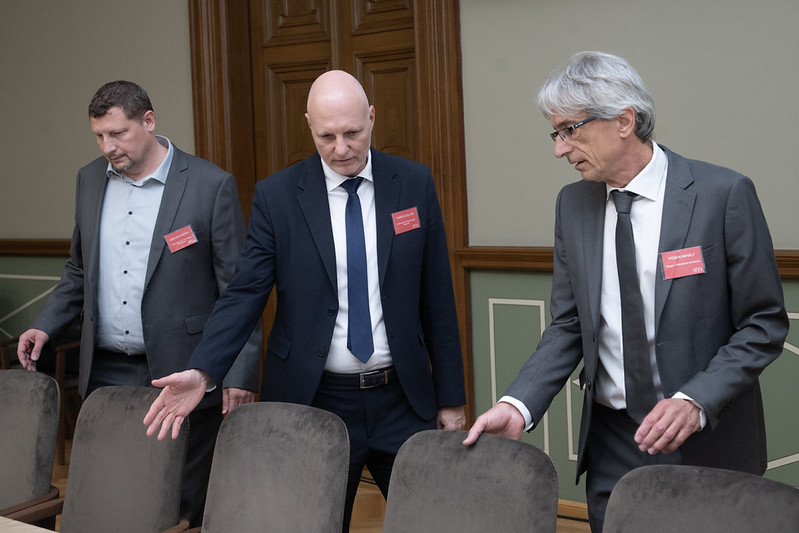
On 11 June 2026, a roundtable discussion was held at the Palace of the Hungarian Academy of Sciences on the future of the Hungarian research network. The event was jointly organized by the Ministry of Science and Technology and the Hungarian Academy of Sciences with the aim of discussing the future operational framework for research institutes currently affiliated with HUN-REN or attached to ELTE, as well as possible steps toward the reintegration of the research institutes into the Academy.
The consultation was coordinated by Zoltán Tanács, Minister for Science and Innovation, Mihály Pósfai, President of the Hungarian Academy of Sciences, and Péter Horváth, State Secretary for Science Policy and Innovation. The meeting was attended by the heads of the research institutes of HUN-REN and ELTE, representatives of the Office of Supported Research Groups, members of the Presidium and Secretariat of the Hungarian Academy of Sciences, representatives of the Ministry of Science and Technology, the Chair of the Research Excellence Council, a representative of the Democratic Trade Union of Scientific Workers, and the Hungarian Young Academy (HYA). HYA was represented by co-chair Bernadette Kun, who consulted with HYA members and alumni working at the relevant research institutes prior to the meeting. As a result of these consultations, numerous valuable suggestions were collected, including from Veronika Barta, Kata Horváti, Júlia Jósvai, Júlia Koltai, Petra Mátyás-Rausch, and Imola Wilhelm.
The roundtable discussion was preceded by extensive consultations, during which the organizers sought to gather the opinions of all relevant stakeholders. The purpose of the professional meeting was not to make specific decisions, but to compile the positions and suggestions of the various stakeholders, which can serve as a basis for decisions to be made in the coming months.
In the opening presentation, Péter Horváth, State Secretary for Science Policy and Innovation, outlined the main elements of the planned reform. The concept presented is based on four fundamental principles: academic autonomy, transparency, long-term stability, and competitiveness. Key priorities include ensuring academic freedom, transparent and accountable governance, predictable funding, and the development of a differentiated performance evaluation system that takes into account the specific characteristics of each scientific discipline.
The participants agreed that the basis for the future operation of the research network could be a unified network in which the Hungarian Academy of Sciences could act as a founder and maintainer. Key elements of the concept presented included strengthening scientific autonomy, resolving the ownership status of research institutes, and reinforcing researcher self-governance. Another key element of the concept was ensuring reliable research careers and multi-year, predictable funding. In the area of performance evaluation, the focus was on developing a differentiated system that takes into account the specific characteristics of individual scientific disciplines, with professional communities playing a decisive role in its elaboration.
According to the concept presented, the well-functioning elements of the current system and certain infrastructure developments should be preserved and further developed rather than entirely discarded. In the governance model proposed, the research community would play a greater role, and young researchers would be included in the governing body of the new structure. The Hungary Young Academy welcomes the fact that the concept provides for the possibility of the organized representation of young researchers.
Following the presentation and the subsequent reflections, participants discussed the most important issues in small groups and formulated recommendations for the next steps. According to participants’s feedback, the meeting was characterized by constructive dialogue, and there was broad agreement on numerous key issues. Tasks for the coming months include developing the institutional model, resolving ownership issues, preparing the necessary legislative amendments, and conducting further consultations with stakeholders. According to plans, the research network will be fully operational under the new framework starting in January 2027.
(Photo: mta.hu / Tamás Szigeti)