

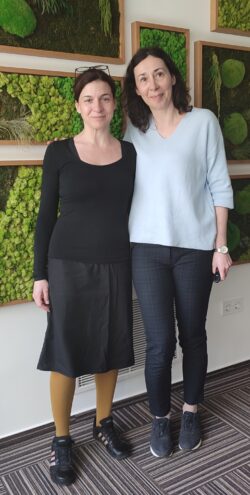
 Júlia Koltai (research professor at the ELTE Centre for Social Sciences, associate professor at ELTE Faculty of Social Sciences, and member of the Hungarian Young Academy) presented, in English, the main results of the joint study conducted by the Hungarian Academy of Sciences and the Hungarian Young Academy under the title “The Situation and Prospects of Young Researchers in Hungary,” with particular emphasis on the situation of young Hungarian researchers and scientists from the discipline of biology.
Completed by more than 5,000 respondents representative of the whole Hungarian research community, the questionnaire surveyed issues related to income, publication and grant application habits, international experience, workload and mental health, as well as barriers to progress in a scientific career. As highlighted in the talk, low wages are typical across the whole sector but particularly affect early-career researchers. According to the results of the survey, young scientists are also affected by a highly unpredictable career path model and an unstable national grant system, which hinders their advancement to becoming independent researchers. Shockingly, almost two thirds of scientists below the age of 40 have already considered abandoning their scientific career.
Researchers in general experience high workloads, and the mental health indicators of the younger cohort are relatively low. Women scientists are particularly affected by different forms of discrimination and bias, including lower incomes, childcare burdens, and difficulties related to breaking the glass ceiling. On the other hand, the scientific environment is usually characterized by a supportive work atmosphere and the opportunity to conduct independent research. International experience, especially spending 3–5 years abroad, increases scientific productivity.
Interestingly, biologists (more precisely, scientists belonging to the Biology Section of the Hungarian Academy of Sciences) seem to stand out in several aspects of scientific life. They produce the highest proportion of Q1 publications and domestic grant applications, while also achieving the lowest scores on psychological well-being tests. During the Q&A session moderated by Imola Wilhelm (scientific adviser at the HUN-REN Biological Research Centre and member of the Hungarian Young Academy), organizer of the event, the audience tried to understand this issue as well as numerous other aspects of the survey results. In addition, participants discussed the possible impact of the findings on decision-makers and PIs, as well as the necessity of future follow-up research to monitor potential changes.