
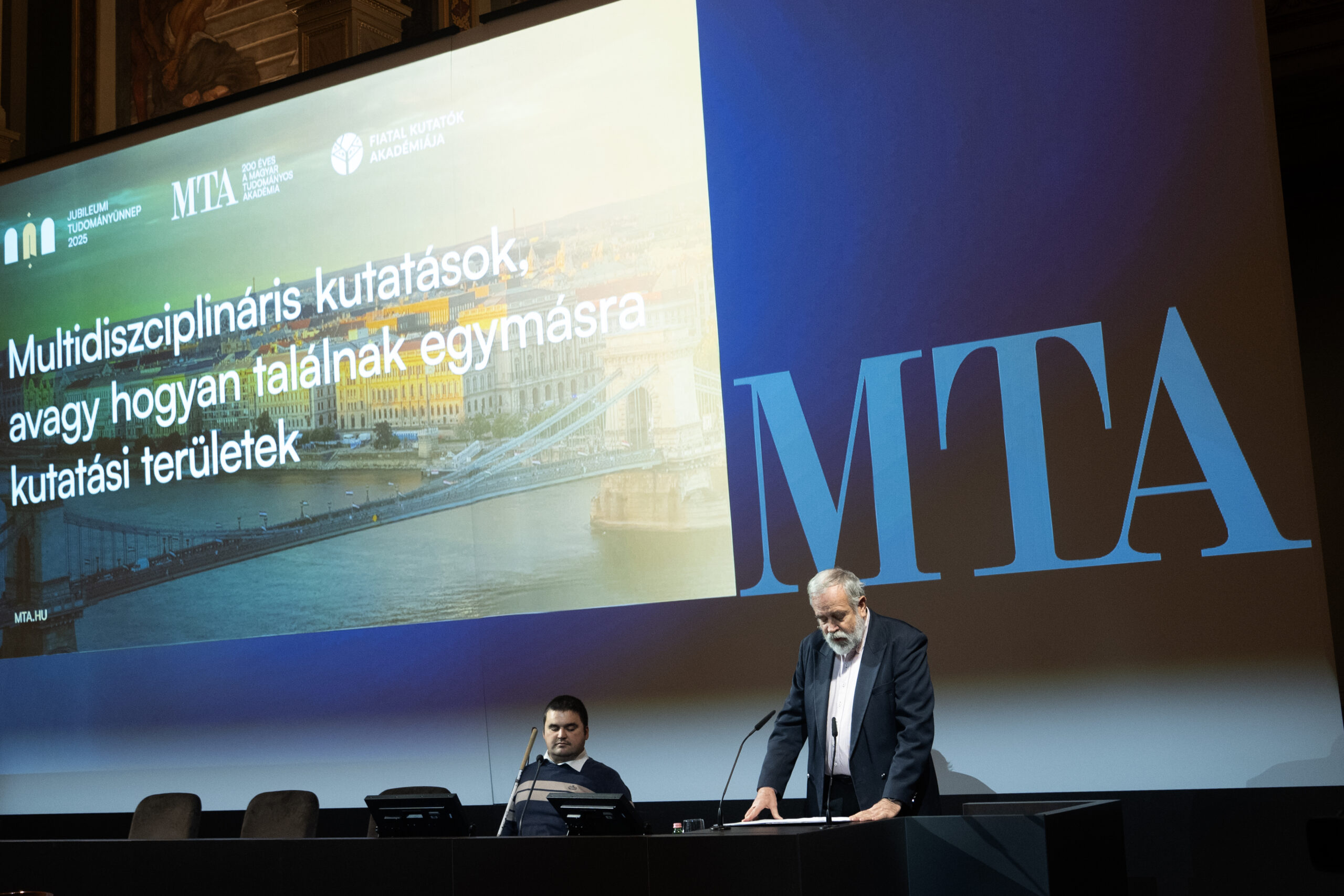
After the opening of the event by Boldizsár Szentgáli-Tóth, Co-chair of the Hungarian Young Academy, László Kollár, Secretary-General of the Hungarian Academy of Sciences delivered his welcome address, in which he drew attention to the fact that in science, not only knowledge but also wisdom, integrity, and cooperation are fundamental values, especially in an age when competition and self-assertion can easily distort the world of research.
This was followed by the presentation of the Zoltán Fekete Young Mentor Awards, established in 2025. The award is named after Zoltán Fekete, who died at a tragically young age and who was an active member of the young researchers’ community. The purpose of the biennial award is to recognize young researchers who stand out with their work in student mentoring. In the first year of the award, 83 valid applications were received. The laurates for 2025: Milán Csaba Badics (Corvinus University of Budapest), Alexandra Kemény (Budapest University of Technology and Economics) and Gyula Nagy (University of Szeged) (from right to left).
The morning session featured four presentations, followed by a roundtable discussion that provided an opportunity for a more in-depth exploration of the topic. First, Zsófia Bíró, innovation manager and research fellow at the University of Pécs Faculty of Law, brought to us some exciting examples to illustrate how legal science intersects with space exploration. She sketched a broad arc from the regulatory challenges of hydrogen production in Hungary to the legal framework for future space energy and nuclear propulsion technologies. HYA member Kata Dévai talked about how Roman recycling practices can be uncovered by combining archaeometry, i.e., archaeology and geochemistry, especially in the case of glass, which was a mass material similar to today’s plastic during the imperial era. Zoltán Kmetty, research professor at ELTE’s Centre for Social Sciences, used publication analyses to highlight how the boundaries of Hungarian sociology are becoming increasingly blurred: sociologists are increasingly publishing in prestigious international journals that are not specifically sociological, and are working more and more often in multi-player, interdisciplinary teams. Finally, Tamás Ruppert and András Zsidó N., both of them HYA members, gave a joint presentation on how the engineering systems approach can be linked to cognitive psychology in human-centred manufacturing, specifically through the data-driven optimization of machines and the real-time, physiology-based monitoring of operators’ attention lapse and decision-making situations.
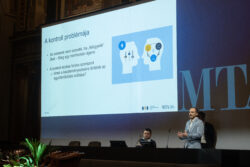
During the roundtable discussion moderated by HYA Board Member Zsuzsa Bagoly, the panellists discussed whether multidisciplinarity is more of a trend, a constraint, or a genuine necessity today, and spoke candidly about the difficulties of cooperation, raising the issue of different “technical languages,” publication and evaluation systems. Participants agreed that the key to successful interdisciplinary work is openness, personal relationships, and bold initiative, and that this approach can best be passed on to the next generation of researchers through experiential examples, mentoring, and community spaces such as the Hungarian Young Academy.
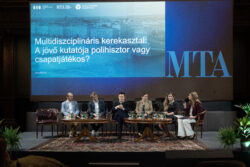
Photo gallery of the event (Photos: mta.hu / Tamás Szigeti)
The afternoon session highlighted the diversity of research conducted by the members of the Hungarian Young Academy – click here for a summary of those presentations.