
Event
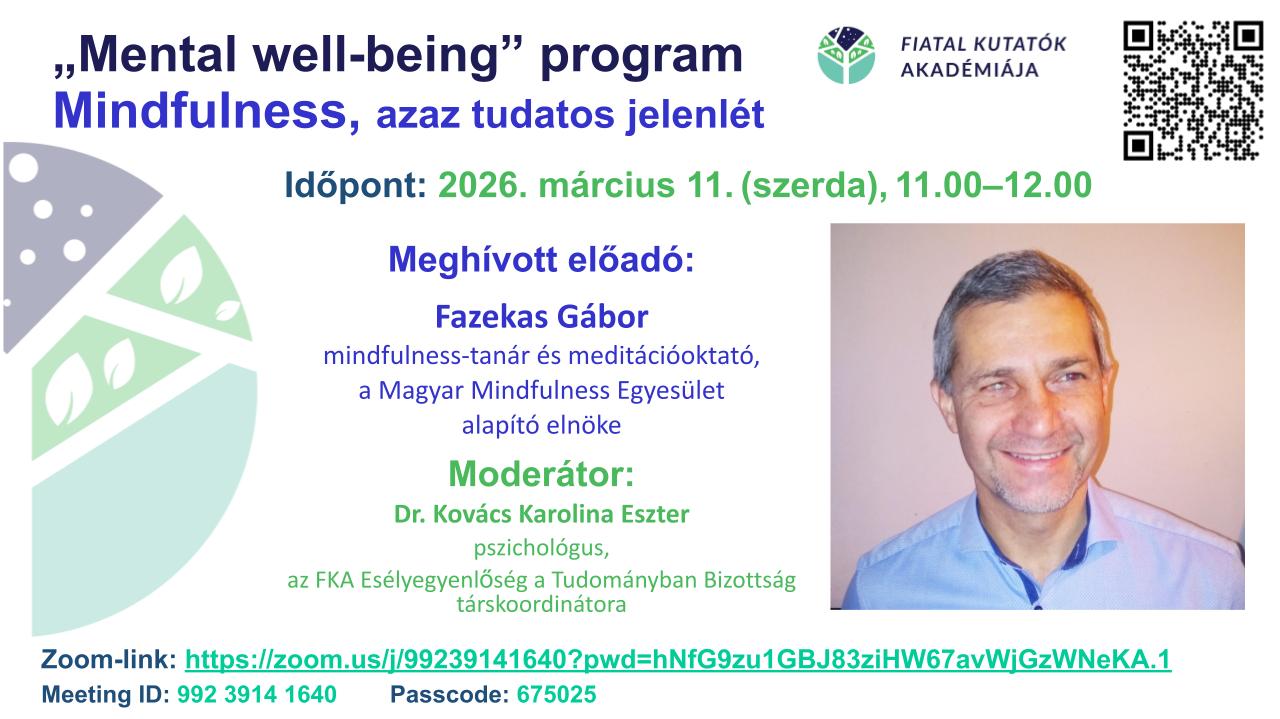
On 11 March 2026, from 11:00 a.m. till noon, the Committee for Equal Opportunities in Science of the Hungarian Young Academy (HYA) is hosting its next webinar on the topic of mental well-being under the title “Mindfulness, or Conscious Presence”.
The online event will feature Gábor Fazekas, mindfulness instructor and meditation trainer, president of the Hungarian Mindfulness Association. The event will be moderated by psychologist and HYA member Dr. Karolina Eszter Kovács.
Location:
https://zoom.us/j/99239141640?pwd=hNfG9zu1GBJ83ziHW67avWjGzWNeKA.1
Meeting ID: 992 3914 1640
Passcode: 675025
Invited lecturer:
Gábor Fazekas mindfulness instructor and mediation trainer, founding president of the Hungarian Mindfulness Association
Moderator:
Dr. Karolina Eszter Kovács (Debrecen University, Faculty of Humanities, Institute of Psychology, Department of Counselling, Development and Educational Psychology), co-coordinator of HYA Committee for Equal Opportunities in Science
About the lecturer:
Gábor Fazekas is the founder of the Center For Mindfulness Hungary, which plays an important role in promoting mindfulness methods and connecting meditation and science in Hungary. He is also the founding president of the Hungarian Mindfulness and Contemplative Association (MMKE), a professional organization founded in 2017. He has been holding mindfulness-based courses and regular meditation sessions for 15 years, and organizes lectures and conferences on the subject. With the personal encouragement and support of Jon Kabat-Zinn, the creator of the first mindfulness-based method, MBSR, he holds MBSR (Mindfulness Based Stress Reduction) teacher training courses.
Abstract:
Mindfulness, or Conscious Presence
The first mindfulness-based method (Mindfulness Based Stress Reduction – MBSR) was developed by Jon Kabat-Zinn in 1979 at the University of Massachusetts Medical School. As its name suggests, it is primarily intended to reduce stress and was initially recommended for people suffering from chronic pain. MBSR is based on simple meditation exercises and easy-to-understand scientific theory related to stress. Research on the method has shown that it has a variety of beneficial effects, which has led to its popularity. Several other mindfulness methods have been developed based on MBSR.
In the early 2000s, there were only about 10 publications per year on mindfulness, but in the 2020s, their number has seen a sharp increase to around 1,500 per year. Some examples of the wide-ranging beneficial effects include stress reduction, alleviation of symptoms of depression and anxiety, lower blood pressure, improvement in eating and sleeping disorders, improved immune system function, improved emotion regulation, better concentration and attention control, and increased empathy and compassion.
The lecture will briefly introduce some of the better-known mindfulness methods to acquaint the audience with the use of each method and for whom it is recommended.
1) Mindfulness Based Stress Reduction
2) Mindfulness Based Cognitive Therapy
3) Mindful Self Compassion
4) Effortless Mindfulness
If time allows, participants may also get a taste of 1-2 brief meditation exercises.
All are welcome!
(Please note that the language of the event will be Hungarian.)
The Hungarian Young Academy (HYA) places a great emphasis on the role of mental health in the life of researchers. We consider it essential to talk about challenges inherent to research careers, including the role of stress in our lives and the method of mindfulness, or conscious presence, to help reduce it. We strive to gain useful information and learn from each other’s experience and coping strategies.
In the spirit of the above, we organise regular lectures on the topic of research careers, which also touch upon questions of mental health.
In October 2021, in the first part of the HYA webinar series on research careers, Dr. Gábor Kismihók, head of the Researcher Mental Health Observatory COST Action gave a talk focusing on work-life balance and the mental health and well-being of researchers. The second chapter of the series, held in October 2022, featured Dr. Bernadette Kun, psychologist, and Dr. Mária Hoyer, clinical psychologist and addictology specialist, who talked about the theoretical and practical background of work addiction and burnout, and the possibilities of diagnosis and treatment. The topic explored by the third part of the series held in November 2023 was the impostor syndrome, where Anett Felházi, clinical psychologist and psychotherapist spoke about the theoretical and practical aspects of the problem. At our event organised in May 2024, biologists Katalin Solymosi and Zsófia Horváth discussed some aspects of the situation of women in (research) leadership and supervision. The last occasion held in May 2025 featured Dr. Tímea Olajos and Noémi Oláh, psychologists, who talked about the adaptive and maladaptive aspects of perfectionism.